|
Click to jump to a profile of members of the 1142nd Combat Engineers Headquarters Company:
Click here to view the full roster of the 1142nd Headquarters Company.
Nicholas
Drahos
Born Ford City, Pa 6/12/18
Read Nicholas Drahos' recollections of the war and excellent history of the 1142nd here.
|
 |
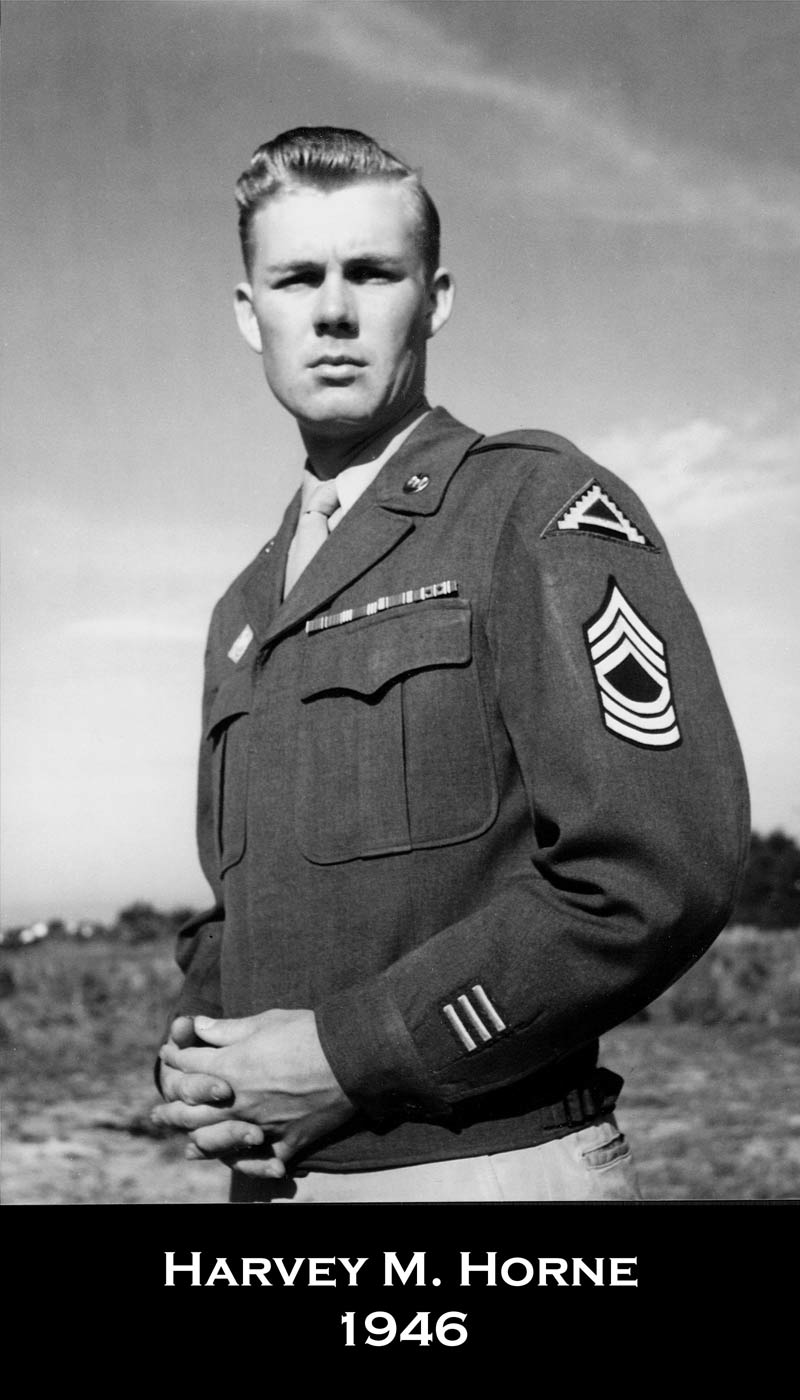
Harvey M. Horne
I am Harvey Maynard Horne and I grew up in Erwin, NC. I reached my 18th birthday on July 26, 1943 and shortly thereafter I received a letter from my local draft board stating that I was to report to Fort Bragg, NC on October 11, 1943. At Fort Bragg I was given a very brief physical examination and was given my choice of services, the army, navy or marines. I chose the army and was sworn that afternoon. They told me to go home but to report back for active duty on November 1, 1943. This I did and this time they gave me another physical and numerous shots along with a set of army clothing. They also gave me several tests. I did real well on the typing test.
We had a short stay in the reception center where we did such things as mopping the mess hall floor, assisting another GI keeping the furnaces in some barracks going and policing the grounds picking up cigarette butts, trash etc. Later, I along with a sizable group of men was taken to Fayetteville, NC where we were loaded onto a train. A ride of several days brought us to an army base which we found out was Camp Crowder, MO.
We were met by a group of army officers and enlisted men and were told that we were now part of the Headquarters Company, 1142d Engineer Combat Group and that our training would start immediately. With my typing skills, I figured that I would get a clerical position but such was not the case. I was told that I was to be the athletic director which was part of the unit's special services section which consisted of one officer and two enlisted men. Needless to say, with basic training taking up most of the time, we didn't have much time for athletics. I did my share of guard duty and KP (washing dishes and pots and pans in the mess hall).
When our basic training was completed we left Camp Crowder for Tennessee to participate in maneuvers. Between maneuver problems we had two or three days to ourselves and this is where I finally got to do some productive work. This involved operating a small unit PX. I had worked in a grocery store before entering the army so this was right down my alley. I would go to Lebanon, TN where the supplies were and pick up candy, cigarettes, beer, etc., and
sell these to the members of the company. I had to keep up with the money and turn it in to the supply depot. After maneuvers were concluded, we stayed in Lebanon for about a month and I operated the PX there.
We moved from this area to Camp Campbell, KY for additional training which included crawling through barbed wire and mud holes while machine gun bullets flew over our heads. We completed this with no injuries but we were all very tired and muddy when we finished.
In the middle of July, I was informed that I had been selected to be part of the advance party of our unit for overseas duty. This party included Col. Bryant, Major Carr, Lt. Mohr, Sgt. Andert and myself. I was given a seven day leave and was able to go home for a few days. I was told not to tell anyone that we were getting ready to be shipped overseas.
The advance party left Camp Campbell and went to Fort Hamilton, NY and then boarded the Aquitania which was an old British liner which had been converted into a troop ship. We left New York on August 6, 1944 and arrived in the Firth of Clyde in Scotland on August 13, 1944. We moved by train to Bristol, England where we were quartered with a unit of the Ninth Army. Another move was to a camp near Salisbury, England and finally to Bournmouth, England where we awaited the arrival of our unit. During this period, I worked with Major Carr and we travelled around picking up vehicles and supplies that would be later used by our personnel.
The unit finally arrived and we crossed the English Channel on an LST and landed on Omaha Beach on September 26, 1944. During this crossing our supply sergeant, Porter Paige broke his hand and had to go to the hospital where he stayed for about two months. During this period, I was selected to fill in for him and with the help of Sgt. Culver S-4 NCO and James E. "Chicken" Johnson, driver, we handled the supply duty until Paige returned.
When Sgt. Paige returned I worked with him for a while but with my typing skills, I bounced around with S-1 (Group Personnel), S-3 (Group Operations) and S-4 (Group Supply).
After the war ended the 1142d was chosen to be deactivated so on June 30, 1945 most of the personnel were transferred to the 1104 Engineer Group. I was placed in the Personnel section and got a promotion from T/5 to sergeant. Later a position in S-4 became available which I got along with another promotion, this time to staff sergeant.
In October 1945 I got a seven day leave to go to Switzerland. This was a very enjoyable trip but when I got back I found that the 1104 Engineers were being deactivated and that I had been transferred to the 1265th Engineer Combat Battalion, Headquarters and Service Company. In addition, I had been promoted to technical sergeant and was the supply NCO in the 1265th. This unit was in Giessen, Germany but in December it moved to Bremen, Germany and became part of the Bremen Port Command.
I stayed in Bremen until the latter part of February 1946 when it was time for me to come home. I also found that I had been promoted to master sergeant for some reason. Why, I did not know. I left Bremerhaven, Germany on the troop ship Lincoln Victory, went through Camp Kilmer, NJ and to Fort Bragg, NC where I received my honorable discharge on March 26, 1946. I found out later that it was a policy in some units to give an extra stripe to men when they left Europe for home so my promotion had been a gift.
Thanks to the GI Bill I was able to attend NC State College (University now) where I received a Degree in Electrical Engineering in 1950. I was employed by Carolina Power & Light Company for over 37 years, serving in Asheboro, Southern Pines, Goldsboro and Raleigh, NC. It was while I was in Asheboro that I met Edith Hendrix, a home economist with the company, and I fell in love with her. We were married after a year of courtship. We have had three children, two boys and a girl. Our first son had Down Syndrome and lived 41 years before passing in 1997. Our other son is married and he and his wife have two sons and a daughter. Our daughter, the family athlete, teaches physical education courses at NC State University.
In retirement, Edith and I have enjoyed our hobbies, gardening, photography and traveling. We have visited all 50 states and been to all continents except Antarctica. In addition, Edith is an avid bridge player and teaches bridge for the City of Raleigh's Parks and Recreation Department.
|
|
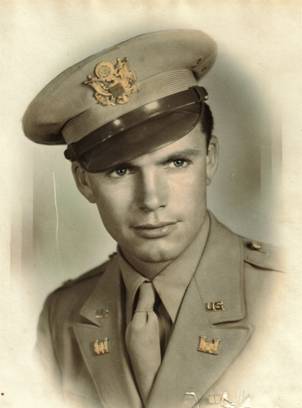
Frank O'Connor
Frank Edward O’Connor was born March 11, 1913 in Fond du Lac, WI, the third of five children born to Joseph and Anna O’Connor. He enlisted in the Army in 1940, while attending college in California. He was stationed at Wheeler Field Army Air Base in Oahu and was there during the Pearl Harbor attack on December 7, 1941. He stayed in Hawaii until December 9, 1942, then graduated as 2nd Lt. from Officer Candidate School at Mt. Monmouth, NJ. He joined the 1142nd at Camp Crowder, Mo. His training was in radio, communication and engineering.
He met his future bride, Blanche Reich, while on maneuvers in Lebanon, TN when the 1142nd was stationed there. Later, at Camp Campbell, KY, he was promoted to 1st Lt. One duty that fell to him while at Camp Campbell, and for a short time while overseas, was that of mail censor. This was a job he truly hated. He was always trying to improve on something or “invent” a better way. While in France, he “invented” a wire-winding machine that made the job of stringing communication wire across France and Germany a little easier. Another account of his “ingenuity” was written about in “Recollections from my Army Service” by Bill Stephenson (January 2007). “Lt. O’Connor got the bright (?) idea of driving a pulley mounted generator to power up some of our billets by jacking up a jeep and letting the rear tires drive the generator. The tire was brought to run against the pulley. This arrangement may have lasted one hour, abruptly brought to a halt when the tire blew. Needless to say, we didn’t get much electric service from this scheme.”
He set up a radio school at Vaals where he was expected to turn out 100 operators before moving on. He was promoted to Captain before the war in Germany ended. He was on a ship destined for the Pacific Theatre when Japan surrendered. He arrived "home" in Lebanon, TN in August and 6 days later married the southern girl that had waited for him for the past year. He remained in the Army Reserves until his retirement as Lt. Colonel in 1965. In civilian life, he was Advertising Manager for The Lebanon Democrat newspaper. He was President of the Kiwanis Club, a Sunday School teacher, a builder and artist, and a loving husband and father.
He passed away August 14, 1966, leaving behind his wife, Blanche and two daughters, Annice and JoNell. He would have loved knowing his two grandchildren: Wendy and Christina and five great-grandsons: Mason, Connor (his namesake), Ethan, Caleb and Jacob. His oldest grandson is now Army -- 2Lt. stationed at Ft. Sam Houston.
In a memorial article written about him upon his death, the newspaper said: "He was a gentleman and a gentle man. The measure of Frank O'Connor was not in his achievements, important as they may be, but in his example of humility, kindness, and cleanliness of thought and conduct before his family and before his fellow men. In our residue of sadness, there glows an ember of joy of having known him."
As his daughter, (and a proud grandmother), I agree.”
|
 |
William
Alga Pace
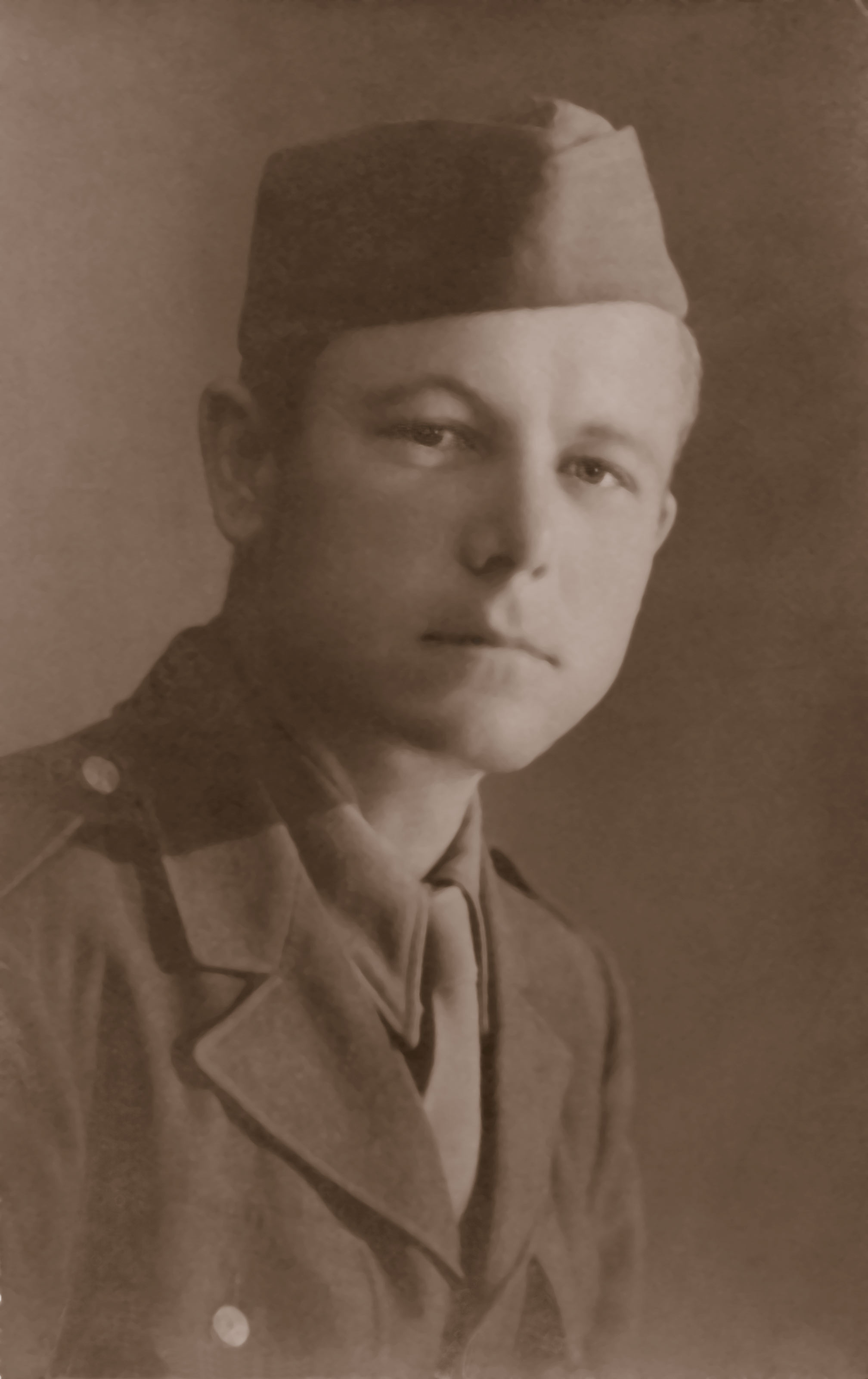
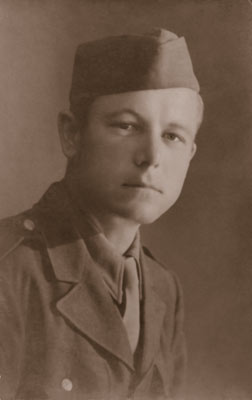
My grandfather, William Alga (Algie) Pace, was
born August 13, 1913 in Mebane, NC. He was one of 11 children
of Newton Lee Pace and Julia Ann Baker.
Algie entered the US Army on October 21, 1943
and served until his honorable discharge on January 13, 1946.
He served with the unit from its formation until November
1944. From October 25th – November 15th, 1944, the headquarters
company was stationed in Sichen, Belgium (current day Zichen
Zussen Bolder) where the unit made a school house its base
of operations. During that period, he was
awarded the Purple Heart for shrapnel wounds received from
a German “buzz bomb” that landed near the school
house. The school house still stands today in Zichen and you can view the pictures of it on the "Photos" page in the Willy Willems gallery.
After his release from the hospital and before
he could rejoin his unit, he was swept up in the Battle of
the Bulge. Sometime during the battle, he was hospitalized
again with severe frostbite of his feet. A US Army surgeon
told Algie he was the luckiest man in the US Army to not lose
his feet with the extreme frostbite he had received. He would always wear multiple pairs of socks because his
feet were always cold.
As to which unit or units
he was attached to after his release from the hospital before
the Battle of the Bulge is not known or stated in his service
record. He returned stateside from Europe on January 8, 1946.
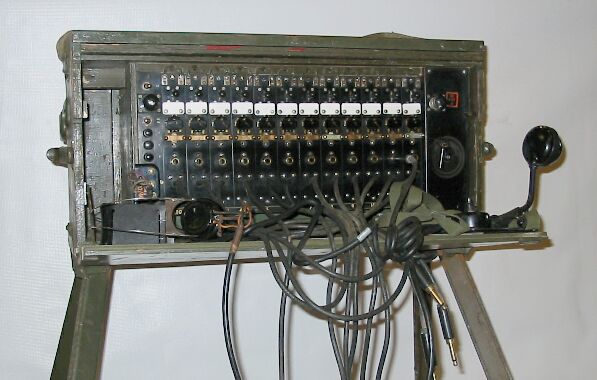
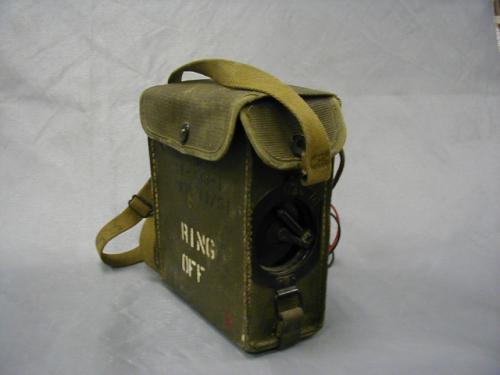
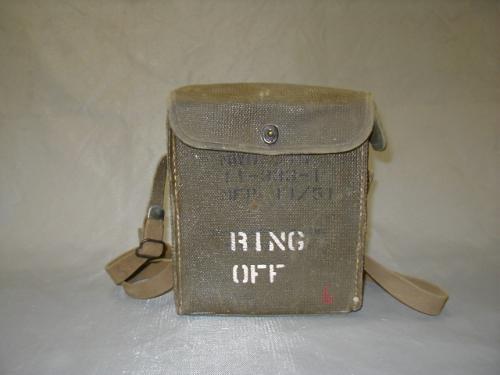
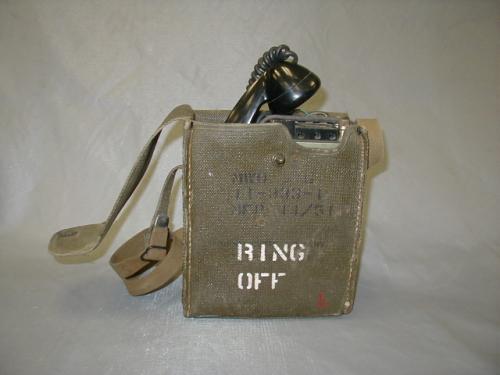
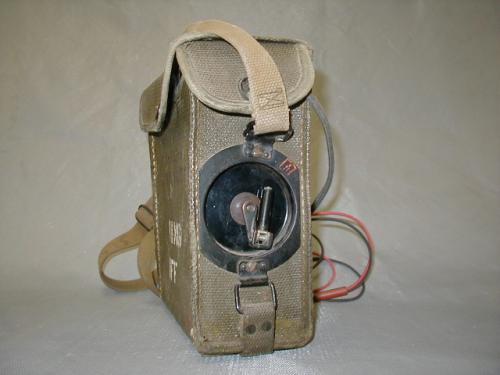
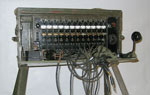
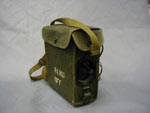
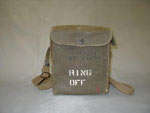
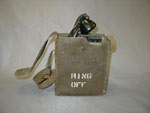
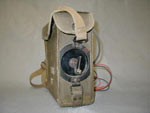
Algie was a switchboard operator and operated both the BD-71
& BD-72 switchboards. The BD-72 switchboard and field phones are pictured to the right.
Algie was married to Annie Mae Davis of Galax, Virginia in December 1941. He went to be with the Lord on September 4, 2009. They
have 2 children, 7 grandchildren, and 15 great grandchildren.
|
Photos courtesy of the Museum
of Communications |
Bernard A. Picchi
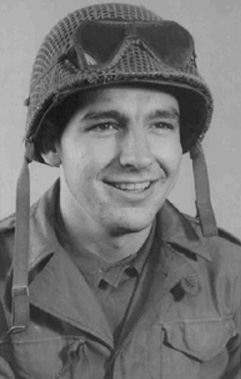
My father, Bernard (Bernie) Picchi, was born March 13, 1924 in Philadelphia, Pennsylvania. He was one of four children of Rustico and Mary Picchi. He died on November 27, 2004 in Sarasota, Florida.
We know very little of my father’s war experience; he never spoke of it. We got a sense it was tough duty, but he kept it to himself. Do not misunderstand; he was not dour or haunted. He was a happy and positive person who always saw the best in people; he had put the war behind him and he refused to look back.
My father was a supplemental resource to the 1142nd. Most men of the 1142nd were from the Piedmont or Sand Hills of North Carolina. My dad was from Philadelphia, so he may not have had the kind of bond many of the NC men did.
There are two stories I can share about my father’s war experience, but they may not be accurate and entirely factual as I was just a child when I pressed my father for his personal history.
My father entered the service as a medic or corpsman (an enlisted man who works as a field medic). As I understand it, corpsmen had special markings on their helmets – a white circle with a red cross – and did not carry the full weapons complement of a combat engineer. Once deployed to Europe, he realized that the enemy found it easy to shoot at medics with their unique helmet markings. He went on an all out campaign to get his duties reassigned so he could have a complete allowance of arms, and shed the undesirable helmet marquee.
The second story is that a group of men in the 1142nd pooled some money and purchased a very good Swiss wristwatch – a Universal Geneve chronograph in a stainless steel case – and held a raffle. My Dad won the raffle. He wore that watch every day of his life.
After completing his military service, my father returned to Philadelphia and enrolled in the Baronian School of Watchmaking. In January, 1947 he completed his course of study and was graduated as a watchmaker. My father enjoyed the craft of watchmaking and watch repair, but never took it seriously as a commercial endeavor. He repaired watches for friends and family his entire life.
After graduating, my father moved to McKeesport, Pennsylvania for work. His uncle introduced him to a friend’s daughter, Patricia Hamilton. They were married on September 22, 1947.
From 1947 to 1956 my father worked for the Kelsey Hayes Wheel Company. When Kelsey Hayes moved their operation to Detroit, he resigned and took a position with Westinghouse Electric at the Bettis Atomic Power Laboratory as the manager of shipping receiving and transportation. During his career at Bettis, he managed the shipment of several reactor cores for both commercial and experimental use, and the reactor cores and fuel assemblies for much of the Nuclear Navy (Bettis was also the home of Pittsburgh Naval Reactors). He retired from Westinghouse with 30-years of service in 1987. My parents retired to Sarasota, Florida.
My father had no contact with his army colleagues until 1985 or 1986. In an unusual way he got word that the 1142nd was planning a reunion. At the time, my brother was a Wall Street equity analyst with one of the investment banks. He published much research. One of his clients was Wachovia Trust. A wife of one of the men of 1142nd (I believe Mahon Flake) worked at Wachovia. She was aware of an effort to track down missing army mates for the reunion. Picchi is a unique surname; she saw it on the reunion list and remembered reading my brother’s research publications. She contacted my brother and eventually the unit got in touch with my father. My father travelled to Asheboro for the reunion. It was very emotional for him as he had not seen these fellows in over 40 years.
At the time of the reunion, I was working at Carolina Power & Light in the corporate office in Raleigh. I learned that some of the men I worked with at CP&L were in my Dad’s unit. Harvey Horne was a safety engineer at the utility and lived only blocks from my house. It turns out that many of the men of the 1142nd attended North Carolina State University after discharge and achieved engineering degrees. I am certain more than one alumnus of the 1142nd worked at CP&L and I may have had first-hand contact with them, or their family members, without ever realizing our connection.
While my father never spoke of his war experience, I am sure the influence of the 1142nd had some impact in forging his character (he was 19 when he was drafted into military service). My father was a wonderful person and dad; he lived the Christian ethic – love God and love your neighbor – more completely than anyone I have known.
He is survived by two sisters, his wife of over 50 years -- Patricia, two sons and daughters-in-law, two granddaughters (whom he loved mightily) and four great grandchildren.
Robert Picchi |
 |
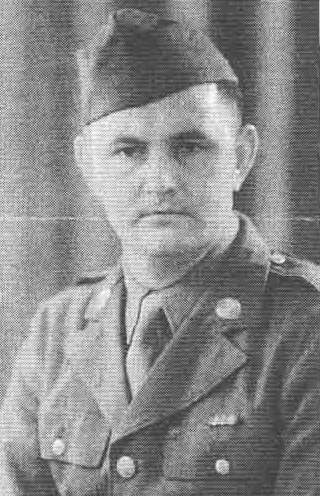
Ben Pugh
The year 1917 found the United States of America involved in the First World War, which was also the year that Ben came into the world on the sixth day of April. Little did his farm parents dream that their first born, only son would one day serve in the US Army during another World War years later.
Ben grew up on a farm that required family efforts all working together During the Great Depression beginning in 1929 farm life, although hard work, provided self-sufficiency while others less fortunate in cities and around the country were adversely affected suffering job losses, hunger, homelessness and other ills. At least there was home-raised food and a place to live for the Pugh family, which later included three more children.
At an early age, a good work ethic was instilled in all family members. Ben became an early entrepreneur. He earned money by setting rabbit traps and checking those each morning before going to school. He dressed and sold those rabbits to the neighborhood general store where locals bought rabbit meat to eat. Ben learned to drive at age eight. Down on the farm, that was all right then. His dad taught him to drive on an old flat-bed truck Driving licenses were not required until the mid thirties, according to Ben's memory. At age sixteen he became a school bus driver having already had eight years of driving experience.
After graduating from Eli Whitney High School in 1935, he immediately left the farm and moved to Greensboro, lived with an uncle and worked at a Service Station. Later he got a job at Mojud Hosiery and learned to knit. He continued hosiery work in Asheboro at Bosong Hosiery Mill. Areas around Greensboro, Liberty, Asheboro and Burlington were then considered “hosiery centers” of the South. When war seemed inevitable, he worked in the defense industry at Newport News, VA and Wilmington shipyards.
In November 1943 Ben was drafted into the Army and received basic training at Camp Crowder, Missouri, where he was assigned to the 1142nd Engineer Combat Group. A bond was established within members of that group, which are still very strong to this day. Those friendships are most important to Ben. The 1142nd performed essential duties which were crucial to the success of land forces and their movements across Central Europe. Ben received two Bronze Service Stars, a Good conduct Medal, and a World War II Victory Medal.
Ben was discharged from the Army in January 1946 and returned home to resume work in the hosiery industry, eventually becoming part owner in a mill in Burlington. That lasted for eight years, but changes were happening in the industry, for example, panty hose, which Ben's business was not set up to make. Rather then buy all new equipment, the business was dissolved.
He then became a car salesman for the next four years. Next came a new venture in clothing. He bought a van and became a middle-man in clothing, buying and selling, for the next twelve years. Extremely good with figures and business in general, this was a success and carried him through to retirement at age 65. However, being work oriented, he never really retired, that is until he reached the age of 89. During his “retirement” for the next 14 years, he drove cars for local dealerships in Graham.
Ben's parents, now deceased, were Charlie Clyde Pugh and Mabel Braxton Pugh. He was brought up in a Friends Church and has a birthright membership in South Fork Friends Church in the Snow Camp area. Ben was married in 1940 to Hazel McDill. They had one daughter, Betty, who passed away in 1982. They settled in Graham in 1955, his residence until his health so deteriorated, at which time he moved to ?Burlington Manor, an assisted living facility, under doctor's orders. There he still resides. Although his body is weak, his mind is good. His long-term memory is excellent. He is extremely loyal to those who have shown him friendship and kindness. In November, 2009 he suffered from injuries in a fall requiring back surgery and rehabilitation. He was well enough to participate in a “Flight of Honor” trip in April, 2010 visiting Washington and the WWII Memorial. He was also very happy to attend the 2010 reunion of the 1142nd Engineer Combat Group. That, as always, was another highlight of his life.
|
Newspaper article on the 1142nd keeping the Allies moving during the war which features Ben can be read here. |
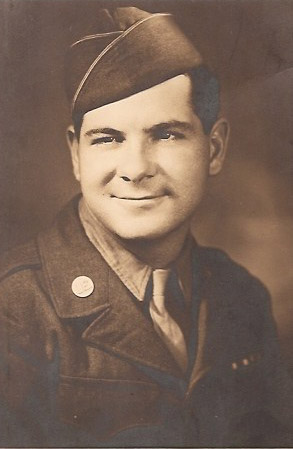
Heath L. Simpson
My father, Heath Simpson, was born 12 July 1925 in Union County,
North Carolina. He was one of ten children of Mac and Carrie Simpson. Dad entered the United States Armed Forces on 6 November 1943. He was assigned to the 1142 Engineer Combat Group as a Truck Driver. While serving in Central Europe he received the EAME Service Medal, two Bronze Stars, Good Conduct Medal, and the World War 11 Victory Medal. On 30 April 1946, he received an Honorable Discharge.
Dad didn’t talk a lot about the war, but he did tell us that the men in the 1142 were like brothers to him. He looked forward every year to the reunions.
After his release from the military he came home and reunited with his girl friend, Edith Greene. They were married on 18 January 1947. Mom and Dad both worked for Cannon Mills in Kannapolis, N.C. On 27 November 1947 Mom gave birth to their first child, me, Edith Lazette Simpson. A few years later, 25 October 1952 my brother Timothy Lee Simpson was born. After a few years Dad left Cannon Mills to work for Kroehler Furniture Manufacturing in Charlotte, N.C. He worked there for 25 years. After leaving there he worked for IMO DeLaval, Pump Division and then the Monroe, City School System. Dad retired from Monroe City Schools on 3 September 1991.
In April of 2000, Dad was diagnosed with Alzheimer’s Disease. On 24 January 2007 the Lord called Dad home. He and Mom had been married 60 years. My husband and I gave them two grandsons, Christopher Maxwell Thomas and Aaron Lee Thomas. My brother and his wife gave them two grandsons, Heath Eugene Simpson and Jason Lee Simpson.
Dad was a kind, humble man who loved the Lord and his family. He was a wonderful husband to Mom, a wonderful Dad to my brother and me, and a wonderful Papa to his grandsons. |
|
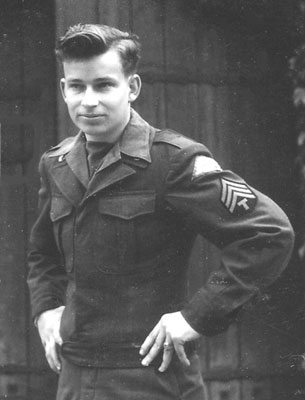
Willliam
H. Stephenson
Read Bill Stephenson's recollections of the war and excellent history of the 1142nd here.
On October 30, 1943, I entered active service
in the Army of the U. S. (soldiers of temporary rank as opposed
to the U. S. Army of permanent ranking soldiers). Inducted
at Fort Bragg, NC, we travelled to Camp Crowder for our basic
training in the Corps of Engineers, more specifically the
1142nd Combat Engineer Group. It was a joke as to the jobs
you were assigned in the Army. Having no typing experience
but with experience in an office setting, I became a “typist”
for the unit’s Adjutant. While in the Tennessee maneuver
area, I had enough spare time to teach myself the touch system
instead of my hunt-and-peck approach I had been using. I remember
placing my GI typewriter atop a large stump, and practicing
my typing. Following the reconstruction of the roads, bridges,
etc. in the maneuver area by the engineers, our unit moved
to Camp Campbell, KY for some training getting us ready to
go overseas. Subsequently, we were moved by train to Camp
Miles Standish, just south of Boston, getting us more ready
for overseas. Having shipped out of Boston, we landed at Liverpool,
England. Approximately 3 weeks later, we crossed the Channel,
landing by LST at Omaha Beach in France. During further moves
throughout the remaining war period, we crossed into Belgium,
Holland, and later Germany, following the movement of the
front line of action against the Germans. Our Group along
with assigned units of battalions and equipment companies,
built and maintained bridges and roads in our areas of assignment.
I was fortunate in not becoming subject to front line warfare.
After the war’s end, I recall an endeavor I was involved
in which cost me one of my rank stripes. Several of us decided
one afternoon we wanted to go to a movie some 20 to 30 miles
away, and I volunteered to take a jeep out of the motor pool,
without an officer’s approval. The movie diversion was
great, but someone had reported the jeep taking and the Company
Commander arranged a meeting for me when I got back to the
Company. The last significant event for me in Europe was a
furlough in Switzerland with a couple of my Army buddies.
Later, the GI Bill afforded me a chance to attend N S State
University to receive a degree in Electrical Engineering.
After many years of employment, I wound up in retirement in
Wilson, NC, where I now reside. |
 |
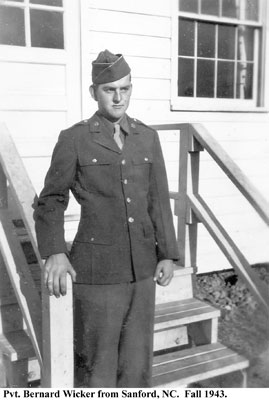
Bernard
Reams Wicker
Bernard Reams Wicker was born on March 5, 1924
in Sanford, North Carolina. He grew up on his father’s
farm, which is located where the Central Carolina Hospital
now stands. The street it is located on is named K.M. Wicker
Memorial Drive after his father, Kinnie Melton Wicker. During
his younger years, Lee County was very rural, made up of mostly
farmland. His large family consisted of his parents and 7
children. His earliest memories are of playing baseball and
tag football with his siblings and other neighborhood children.
During one of those baseball games, he broke his nose, and
it is still crooked. Another childhood memory is his father
having to stop using his car, a 1919 Chevrolet, during the
Great Depression because he could no longer afford gasoline.
As a boy, he had to walk when he wanted to go somewhere; church
and school were the main places. He attended public school
until 12th grade when he was drafted to serve in the United
States Armed Forces on October 1, 1943. He was assigned to
the 1142nd Engineer Combat Group. His three older brothers,
Jim, Bill, and Ken, had already been drafted. He served in
the headquarters company until 1946 rising from private to
corporal and earning several different medals for his service.
After his release from the military in March 1946, he finished
what was left of his high school education, and graduated
with his high school diploma in June of that year.
He worked on his father’s farm upon graduating
from high school. They grew corn, cotton, tobacco, and wheat
along with other vegetables, which were canned for private
use. After working on his father’s farm, he got a job
working at Cornell Dublier, a local electronics factory that
produced such things as television condensers and rotaries.
It was at this time he started dating his future wife, Mildred
Marie Leath Minter, a widow with a small son, Tilla Muscoe
Minter. They started dating in 1953 after being friends since
1951. They were married on March 31, 1956 at Buffalo Presbyterian
Church where they had met five years earlier. By the time
they got married, he had started working for the United States
Postal Service as a window clerk. He would continue working
at the post office for the next twenty-seven and a half years.
On August 25, 1957, the couple had a new addition to their
family, Robert Milton Wicker.
Mr. Wicker is currently retired from
the United States Postal Service and all other jobs. Both
of his sons are now grown; the first married on October 12,
1984, and has a son, Jordan Tilla Minter, born on September
26, 1987. He owns his own business, C.V. Driveshaft Products.
His second son has never been married and owns his own business,
N.C. Computer Services. Mr. Wicker enjoys woodworking, something
he’s done ever since he was young, with his newfound
spare time. He also enjoys doing crossword puzzles, watching
classic westerns, and spending time with his family. He is
an example of an American citizen who has done his part to
keep this country running and make it the greatest place in
the world.
Bernard Reams Wicker
81
Sanford, Lee County, North Carolina
March 5, 1924
Grandfather
Marie Wicker
March 31, 1956
Tilla Muscoe Minter, Robert Milton Wicker
Kinnie Melton Wicker, Margaret Irene Wicker
James Harold, William Brooks, Kenneth Monroe, you, Annie Louise,
Fred Raymond, Mary Margaret
Served in United States Armed Forces from October 1943 to
March 1946; engineer combat unit; private moved up to corporal
|
 |
|